
Cyclorama Projector Screen Government Tender Bid Supplier in India
Rudraksh Industries is a GeM-registered cyclorama projector screen supplier in India, supplying curved, panoramic projection screens for auditoriums, immersive display setups, planetariums and large-format presentation spaces from our Nehru Place, Delhi office. As a government tender bid India specialist and authorized dealer in India for large-format projection screens, we handle single-installation orders as well as bulk, multi-venue government and institutional projects, with GST-invoiced billing and PAN-India delivery covering Delhi, Noida, Faridabad, Gurgaon, Ghaziabad and Greater Noida.
A cyclorama projector screen is a curved, wraparound projection surface designed to fill a viewer's peripheral vision, creating an immersive, panoramic viewing experience rather than the flat, bounded rectangle of a standard flat screen. Originally associated with theatrical backdrop and stage design, the cyclorama format has been adopted in modern AV installations for planetariums, immersive exhibition spaces, simulation and training centres, large auditoriums, and premium corporate or museum presentation environments where a standard flat screen simply cannot deliver the sense of scale and immersion the space calls for.
India's large-format projection screen market is served through a combination of specialist AV integrators, manufacturer-authorized distributors and a smaller number of general electronics resellers who often lack the technical depth curved-screen installations require. A cyclorama screen installation is meaningfully more involved than hanging a flat screen — it requires precise curved frame fabrication, multi-projector edge-blending calibration in many installations, and acoustic and structural considerations specific to the venue. Rudraksh Industries operates as a b2b supplier in India for cyclorama and other large-format projection screens, sourcing through genuine channels and working with experienced installation partners so the curved geometry, mounting structure and projector alignment are all specified correctly from the outset rather than corrected after a poor installation.
As one of the manufacturers and suppliers India institutions turn to for large-format and immersive display projects, we see three recurring buyer categories: government and PSU-run auditoriums, museums and cultural institutions procuring immersive display infrastructure through formal tender routes, corporate and educational institutions building flagship presentation or training spaces, and specialist venues — planetariums, simulation centres, themed exhibition spaces — where a curved or panoramic screen is central to the visitor experience rather than incidental. Each of these has different structural, acoustic and multi-projector requirements, and we scope the screen specification, frame fabrication and projector configuration together rather than treating the screen as an isolated product purchase.
Ambient light control is one of the most decisive factors in whether a cyclorama installation succeeds visually. Because a curved screen wraps around the viewer's field of vision, any stray light — from windows, exit signage, or spill from adjacent projectors — is far more noticeable and disruptive than on a flat screen viewed head-on from a fixed seating position. Venues built specifically for cyclorama or immersive display, such as purpose-built planetariums, typically control ambient light from the design stage, while retrofitting an existing auditorium or exhibition hall for a curved screen often requires additional light-control measures — blackout treatments, adjusted signage placement, or repositioned lighting fixtures — to be planned alongside the screen installation itself rather than addressed afterward as a fix for disappointing image quality. We raise this early in every project discussion precisely because it is far cheaper and simpler to address during initial planning than after a curved screen and projector system has already been installed and commissioned in the venue.
Immersive Curved-Format Screens for Auditoriums and Exhibition Spaces
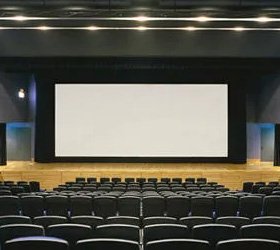
A properly installed cyclorama or curved-format screen transforms a large auditorium or exhibition space by filling a viewer's peripheral vision, an effect a flat screen of the same width simply cannot replicate. As a wholesale supplier India government and institutional venues rely on for large-format display infrastructure, Rudraksh Industries scopes the venue's dimensions, seating layout and projector throw distance before finalising screen curvature and frame specification, ensuring the finished installation delivers genuine immersive viewing rather than a compromised, distorted image from an incorrectly specified curve radius. Tiered seating, as shown here, is common in auditorium-style cyclorama venues, and the curvature must account for the full range of viewing heights and angles across every row, not just the centre seats.
How to Choose the Right Cyclorama Projector Screen Solution
Screen Material Deep Dive
Material choice affects a cyclorama installation as much as curvature does. Matte-white vinyl or fabric surfaces offer the widest, most even viewing angle and the truest colour reproduction, suiting installations where ambient light is well controlled and viewers are spread across a wide seating arc. High-gain materials reflect more light back toward the audience, useful in venues with longer throw distances or lower-lumen projectors, though at some cost to viewing-angle uniformity — a consideration that matters more on a curved surface than a flat one since viewers sit at a much wider range of angles relative to the screen. Ambient-light-rejecting (ALR) materials use directional micro-structures to reject light from angles outside the projector's throw path, valuable for venues that cannot achieve full blackout conditions. Acoustically transparent, perforated screen materials allow speakers to be mounted directly behind the curved surface, keeping sound origin aligned with the visual action rather than coming from off-screen side speakers — a detail that matters considerably for planetarium and immersive-narrative installations where audio-visual alignment affects the sense of realism.
Types and Variants
Cyclorama and curved-format screens vary primarily in curvature radius and material. A gentle-curve format suits large auditoriums where the goal is a wider effective field of view without the full wraparound effect of a true cyclorama installation. A deeper, more pronounced curve suits dedicated immersive spaces — planetariums, simulation centres, themed exhibitions — where the panoramic effect is the central design intent. Screen material also varies: matte-white surfaces suit single-projector installations with controlled ambient light, while specialist high-gain or ambient-light-rejecting (ALR) materials suit venues that can't fully control room lighting, and acoustically transparent perforated materials allow speakers to be mounted directly behind the screen for venues needing sound to originate from the same direction as the image.
Key Specifications to Evaluate
Buyers should evaluate: curvature radius matched to the venue's seating layout and viewing angles (an incorrectly specified radius creates distorted or unevenly bright images at the screen edges), screen material gain and viewing-angle performance, structural mounting requirements (curved frames typically need more substantial and precisely engineered support than flat screens of equivalent size), and — for any multi-projector installation — edge-blending compatibility, since a cyclorama screen large enough to need multiple projectors requires the screen surface, projector placement and blending software to all be specified together rather than the screen being purchased in isolation. Acoustic properties matter too where the screen sits in a venue with live sound reinforcement or speech reinforcement requirements.
Cyclorama vs Standard Flat Screen — A Practical Comparison
A standard flat projection screen costs less, installs faster, and suits the vast majority of conference rooms, classrooms and general-purpose auditoriums where a rectangular image adequately serves the content being shown. A cyclorama or curved-format screen costs significantly more, requires custom frame fabrication and more careful projector alignment, but is the only option that delivers a genuinely immersive, peripheral-vision-filling viewing experience — appropriate specifically for venues where immersion itself is the point, such as planetariums, flagship exhibition spaces or premium simulation and training environments. We assess whether a venue's actual purpose justifies the additional cost and installation complexity of a curved format before recommending it over a standard flat screen.
Where Cyclorama Projector Screens Are Deployed
We supply cyclorama and curved-format screens into government and PSU-run auditoriums and cultural venues, museums and science centres building immersive exhibition or planetarium spaces, corporate flagship presentation and briefing centres, educational institutions building specialist simulation or training facilities, and themed entertainment or hospitality venues seeking a premium visual centrepiece. Each of these venues has a distinct seating geometry, ambient lighting profile and projector budget, and the curvature, material and multi-projector configuration all need to be specified together against the specific venue rather than treated as a standard, off-the-shelf product.
Structural and Rigging Considerations
Curved-frame installations place different structural demands on a venue than a standard flat screen mount. The frame itself needs to be engineered to hold its curved shape under the tension of the screen material without sagging or distorting over years of use, and larger installations often require ceiling or wall anchoring points that a standard venue may not already have in place, particularly in retrofitted spaces originally designed for flat-screen or non-projection use. Projector rigging for multi-projector cyclorama setups typically needs to be positioned precisely relative to the curve, often from ceiling mounts rather than table or rear placement, and this rigging work should be planned alongside the civil and electrical contractors on any new-build auditorium or exhibition space rather than retrofitted after the room is otherwise finished.
Installation, Multi-Projector Calibration and After-Sales Support
Cyclorama screen installation typically involves structural frame fabrication specific to the venue's dimensions, precise projector positioning (often requiring ceiling or rear-mount rigging for multiple projectors), and edge-blending calibration where more than one projector covers the curved surface, so the seams between projected images are invisible to viewers. Our after-sales relationship continues with recalibration support if projectors are serviced or replaced individually, screen surface cleaning and care guidance (curved fabric surfaces need different handling from rigid flat panels), and coordination for any structural adjustment needed if the venue's seating or layout changes after initial installation.
Total Cost of Ownership and Project Planning
A cyclorama screen project's real cost extends well beyond the screen material and frame itself. Structural fabrication for a curved frame is typically custom-engineered per venue, multi-projector installations add the cost of edge-blending hardware or software and the additional projectors themselves, and rigging or ceiling-mount work for projectors often requires coordination with a venue's existing structural engineering. Ongoing costs include periodic recalibration if projectors are serviced individually, and screen surface cleaning that differs from flat rigid panels since fabric-based curved surfaces need gentler handling. We itemise all of these during project planning rather than quoting only the screen material cost, since a curved-screen project underbudgeted on structural or calibration work is a common source of delays and cost overruns on institutional projects.
Common Buying Mistakes to Avoid
The most frequent mistake we see is specifying a cyclorama screen's curvature radius without properly modelling the venue's actual seating layout and viewing angles first, resulting in an installation where seats at the edges of the room see a distorted or dimly lit image compared to the centre. The second common mistake is treating the screen as a standalone purchase separate from projector selection and placement, when in practice the screen material, curvature and projector throw distance and lens type all need to be specified as one integrated system — a screen bought before the projector configuration is finalised very often turns out to be the wrong size, curvature or material for the actual installation.
Why Businesses Choose Rudraksh Industries for Cyclorama Projector Screen
Buying large-format projection screens through the grey market or an unspecialised reseller carries real risk for a cyclorama installation specifically, since curved-screen frame fabrication and multi-projector calibration require genuine technical expertise that a general electronics reseller typically doesn't have. Rudraksh Industries is a gov registered supplier India government departments, museums and cultural institutions can verify directly, and every installation we manage is backed by documented, GST-invoiced supply and coordinated installation support.
For government, museum and cultural-institution buyers, we operate as a gov bid supplier India departments engage for formal government tender bid India procurement of auditorium and exhibition-space display infrastructure, preparing technical compliance sheets, structural and material datasheets, and pricing structured for e-tender bid supplier India submissions. As gov bid contractors India departments have worked with on complex venue projects, we understand the documentation and site-survey requirements formal procurement demands, and as a gov bid dealer India entity we manage that paperwork alongside the technical scoping work.
For corporate, educational and venue buyers closer to home, we function as a dealer near me India search consistently surfaces for the Delhi NCR region — our Nehru Place office puts us within same-day reach of most venues across Delhi, Noida, Gurgaon, Faridabad, Ghaziabad and Greater Noida, where we can survey a venue in person before specifying screen curvature and projector layout rather than quoting blind from a floor plan alone. Buyers searching for a supplier near me India or a nearest dealer in India option for large-format screens reach a team that visits the actual site.
As a wholesaler near me India venues and institutions rely on for large-format display infrastructure, we structure multi-screen or multi-venue orders — for a chain of exhibition spaces, or a government cultural department fitting out several auditoriums — with consistent specification and installation quality across every site, volume-based pricing, and one consolidated invoice rather than a separate purchase order per venue. Our dealer network India spans authorized relationships across several projection screen and projector manufacturers, so we're rarely limited to a single supplier's material or curvature options when a venue's requirement is unusual.
Every project includes pre-installation venue survey to model seating angles and viewing distances, structural and projector-integration planning, and ongoing after-sales support for calibration and screen care — the complete package a nearest supplier in India for immersive display infrastructure should offer, backed by a physical Delhi office and genuine installation expertise rather than a screen sold without any accompanying technical support.
Consistency across a multi-venue rollout is treated as seriously as the specification of any single screen. When a government cultural department fits out several regional auditoriums, or a museum chain builds matching immersive exhibits across multiple locations, every installation follows the same curvature standard, material specification and calibration process — a detail that saves a facilities or cultural-affairs team enormous ongoing coordination effort compared with venues built to inconsistent specifications by different vendors over time. As a manufacturers and suppliers India institutions return to for repeat cultural and educational infrastructure projects, we retain full records of exactly what was specified and installed at each venue, so future maintenance, recalibration or expansion work can match the existing standard precisely.
Finally, because a cyclorama installation is a long-term venue asset rather than a disposable purchase, the relationship with a supplier matters well beyond the installation date. As a local dealer in India with a physical Delhi presence, we remain the same point of contact for recalibration after projector servicing, screen surface care questions, and future expansion if a venue adds seating capacity or additional projection zones, rather than institutions needing to locate a new specialist vendor each time a follow-up need arises years after the original installation.
Bulk & GeM Procurement for Cyclorama Projector Screen
Rudraksh Industries is a GeM-registered dealer, distributor, supplier and wholesaler for Cyclorama Projector Screen in India, supporting both direct wholesale/bulk orders and formal government tender procurement through the Government e-Marketplace (GeM). Corporate offices, educational institutions, retail chains and system integrators regularly need Cyclorama Projector Screen in quantities beyond a single-unit purchase, and as a wholesale distributor we structure pricing, delivery scheduling and configuration standardisation specifically around bulk requirements — one point of contact, consistent configuration, volume-based pricing and one consolidated GST invoice.
Why Buy Cyclorama Projector Screen From Rudraksh Industries
Every order — one unit or two hundred — runs through the same GST-invoiced, GeM-compliant process.
Explore our Homepage
Frequently Asked Questions
What is a cyclorama projector screen used for?
A cyclorama projector screen is a curved, panoramic projection surface used to create an immersive viewing experience in auditoriums, planetariums, exhibition spaces and simulation centres, filling more of a viewer's peripheral vision than a standard flat screen.
Is Rudraksh Industries an authorized dealer for cyclorama and large-format projection screens in India?
Yes. Rudraksh Industries is a GeM-registered, GST-invoiced authorized dealer sourcing large-format and curved projection screens through genuine channels, working with experienced installation partners for structural and multi-projector calibration work.
Can government departments and museums procure cyclorama screens through GeM?
Yes. As a gov registered supplier India departments and cultural institutions can verify on the Government e-Marketplace, we support formal government tender bid India procurement for auditorium and exhibition-space screen installations with complete technical documentation.
Do cyclorama screen installations require multiple projectors?
Larger cyclorama installations often do, and in these cases the screen material, curvature and projector placement need to be specified together with edge-blending calibration, so the seams between multiple projected images are invisible to viewers.
How do I find a cyclorama projector screen dealer near me in Delhi NCR?
Rudraksh Industries is based in Nehru Place, Delhi and directly serves venues across Delhi, Noida, Faridabad, Gurgaon, Ghaziabad and Greater Noida, surveying sites in person before specifying screen curvature and installation, with PAN-India delivery available for other locations.
What is the biggest mistake to avoid when specifying a cyclorama screen?
The most common mistake is specifying the screen's curvature radius without first modelling the venue's actual seating layout and viewing angles, which can leave edge seats with a distorted or dimly lit image. Screen and projector selection should always be scoped together as one system.
What after-sales support is provided for cyclorama screen installations?
We provide recalibration support if projectors are serviced or replaced, screen surface care guidance specific to curved fabric surfaces, and coordination for structural adjustments if a venue's layout changes after the original installation.
How does ambient light affect a cyclorama screen installation?
Ambient light is far more disruptive on a curved screen than a flat one, since the surface wraps around the viewer's field of vision. We assess ambient light conditions during venue survey and can recommend blackout treatments or ambient-light-rejecting screen materials where full light control isn't achievable.
What screen material is best for a planetarium or immersive-narrative installation?
Acoustically transparent, perforated screen materials are often preferred for these installations, since they allow speakers to be mounted directly behind the curved surface, keeping sound origin aligned with the visual action for a more realistic immersive experience.
Can Rudraksh Industries manage a multi-venue cyclorama screen rollout for a government cultural department?
Yes. We support multi-venue projects with consistent curvature, material and calibration standards across every site, structured as bulk orders with full GeM-compliant documentation for government tender procurement.
What structural work does a cyclorama screen installation typically require?
Curved frames need to be engineered to hold their shape without sagging, and often require ceiling or wall anchoring points a venue may not already have, particularly in retrofitted spaces. Structural and rigging work should ideally be planned alongside civil and electrical contractors on new-build venues.
Should projector selection be finalised before or alongside cyclorama screen selection?
Alongside. Screen material, curvature and projector throw distance and lens type all need to be specified as one integrated system — buying the screen before finalising projector configuration is a common mistake that often results in the wrong size, curvature or material for the actual installation.
Does Rudraksh Industries supply cyclorama screens as a bulk wholesaler for multiple auditoriums?
Yes. As a bulk wholesaler for large-format projection screens, we supply and coordinate installation across multiple auditoriums or exhibition halls in a single project, with standardised specification and one consolidated invoice for the entire order across every venue in the rollout.