

Amplifier Wholesale Supplier in India
An amplifier is the component that makes every public address, conferencing, auditorium and background-music system actually work, taking a low-level audio signal from a microphone, mixer or source device and driving it to a level that can power speakers across a room, hall or entire campus. Rudraksh Industries is an Amplifier wholesale supplier in India, supplying PA amplifiers, mixer amplifiers and power amplifiers to corporate offices, government departments, educational institutions, places of worship and hospitality venues across Delhi NCR and PAN India.
As a b2b supplier in India for amplifiers, we work with system integrators, facility managers and procurement teams to specify the correct amplifier type, wattage and channel configuration for the space and speaker system involved, rather than simply quoting a wattage number in isolation, backed by GeM registration and GST-invoiced billing for both single-unit and bulk institutional orders. From a single mixer amplifier for a small conference room to a fully zoned, fire-alarm-integrated paging system spanning a multi-building campus, we treat amplifier selection as a system design exercise rather than a single product sale, because the amplifier is only as good as its match to the speakers, zoning and compliance requirements it is actually serving.
Types of Amplifiers We Supply
PA (Public Address) amplifiers are the standard choice for announcement and paging systems in offices, schools, factories, railway platforms and government buildings, typically built around 100V line (constant voltage) output, which allows many speakers to be wired across a large area on a single amplifier without the impedance-matching complexity of low-impedance direct-wired systems. Mixer amplifiers combine a basic audio mixer — with multiple microphone and line inputs, tone controls, and often a built-in chime or priority-override function for emergency announcements — with a power amplifier stage in a single unit, making them the practical choice for small to mid-size venues that need to combine a few microphones and a music source without a separate standalone mixer. Power amplifiers are pure amplification stages with no built-in mixing, intended for use downstream of a separate mixer or digital signal processor in larger, more complex installations such as auditoriums, conference centres and professional sound reinforcement systems, where flexibility and channel count matter more than an all-in-one convenience. Zone amplifiers and multi-zone systems allow different areas of a building — different floors, wings or rooms — to receive independent audio content or announcements from a shared amplifier rack, which is standard for larger office buildings, retail chains and educational campuses where not every space needs to hear the same content simultaneously. Portable and battery-backed amplifiers serve mobile announcement needs, outdoor events and emergency backup scenarios where mains power cannot be guaranteed.
Key Specifications To Evaluate
Power output, measured in watts RMS (not peak or PMPO figures, which considerably overstate real-world performance), should be sized to the total speaker load plus a reasonable safety margin, typically 20 to 30 percent above the sum of connected speaker wattage, to avoid running the amplifier at its absolute ceiling continuously, which shortens component life and increases distortion risk. Output configuration — 100V line output for wide-area paging versus low-impedance (4 or 8 ohm) direct speaker output for smaller, higher-fidelity installations — determines both wiring approach and the type of speakers that can be connected, and mixing the two approaches incorrectly is a common and costly installation mistake. Number of input channels and their type (balanced XLR microphone inputs, line-level inputs, Bluetooth or network audio input) determines how many microphones, background music sources and paging stations can be connected simultaneously without an additional mixer. Priority and emergency-override functions matter significantly for institutional and public-safety-relevant installations, allowing an emergency announcement or fire-alarm-linked message to automatically override background music or a lower-priority announcement already in progress, a feature that is effectively mandatory for schools, government buildings and any venue with fire-safety compliance obligations. Protection circuitry — short-circuit, thermal and overload protection — affects long-term reliability, particularly for systems run for extended daily hours or in venues with variable, sometimes unstable mains power.
Applications Across Sectors
Corporate offices use amplifiers primarily for paging and background music systems, typically zone-configured so reception, open floors and meeting rooms can each be addressed independently, alongside conference room amplification for larger meeting and training spaces. Educational institutions rely heavily on PA amplifiers for daily announcements, bell/period signals, and increasingly for emergency notification systems that need to reach every classroom and corridor reliably and simultaneously. Government departments and PSU offices specify amplifiers for both routine office paging and, in many buildings, formal public address systems that fall under fire and life-safety compliance requirements, procured through GeM and formal tender processes. Places of worship represent one of the most demanding common applications, since a mixer amplifier or larger PA system needs to handle live vocals, sometimes musical instruments, and reach a large hall or open courtyard clearly and without feedback, often for extended daily or weekly usage. Retail and hospitality venues use amplifiers for background music and in-store announcements, generally favouring cleaner audio quality and zone flexibility over the raw output levels needed for a large public paging system. Auditoriums, banquet halls and event venues need higher-power, professional-grade amplification, frequently as part of a larger sound reinforcement system with separate mixers, processors and multiple amplifier channels feeding different speaker groups such as mains, subwoofers and monitors.
Amplifier Placement and Rack Installation
Where and how an amplifier is physically installed affects both its reliability and how easy the system is to maintain over its working life. Amplifiers generate heat during operation, particularly when driven near their rated output for extended periods, so mounting location needs adequate ventilation, whether that means a ventilated equipment rack with proper spacing between units, or a wall-mounted enclosure that does not trap heat around the unit. For institutional installations with multiple amplifiers, zone controllers and mixers, a proper 19-inch equipment rack keeps the system organised, makes cable management and future servicing considerably easier, and allows additional amplifiers or zones to be added later without re-wiring the entire installation from scratch. Placement should also consider physical security and access: amplifier racks in schools, government buildings and public venues are commonly installed in a locked equipment room or cabinet, both to prevent tampering and to keep the system's volume and configuration controls away from unauthorised users, while still remaining accessible to facility staff for routine operation and maintenance.
Redundancy, Maintenance and System Longevity
For installations where the PA or paging system is genuinely mission-critical — fire and life-safety notification in particular — redundancy planning becomes as important as amplifier selection itself. This can mean a backup amplifier ready to take over a critical zone if the primary unit fails, a battery backup or uninterruptible power supply so the system continues functioning during a mains power outage, or both, depending on the compliance requirements and risk tolerance for the specific building. Routine maintenance for amplifiers is comparatively light compared to mechanical equipment, but periodic checks are still worth budgeting for: verifying that protection circuitry and priority-override functions still trigger correctly, checking connections and cable runs for corrosion or damage (particularly relevant for outdoor or semi-outdoor speaker runs), and confirming that zone routing and volume settings have not drifted from their intended configuration after routine building use, staff changes or ad hoc adjustments over time. A system that was correctly zoned and calibrated at installation can quietly drift out of its intended configuration over months or years of everyday use unless someone periodically checks it against the original design.
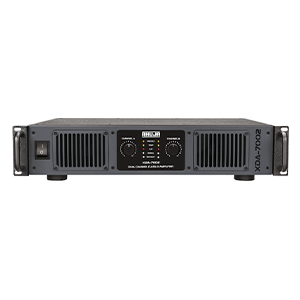
Amplifiers Sized To Your Speaker Load And Zoning, Not Guessed
We calculate total connected speaker load, confirm whether your venue needs 100V line or direct low-impedance output, and check emergency-override and zoning requirements before quoting, so the amplifier that arrives is correctly matched to your building rather than an arbitrary wattage figure picked off a spec sheet. For multi-zone campuses and multi-site rollouts, we also help plan zone boundaries around how the building actually operates day to day, not just its physical layout, so announcements and background audio reach the right areas without unnecessary retrofitting later.
How to Choose the Right Amplifier Solution
Start by identifying whether your installation needs a 100V line system or a low-impedance direct speaker system, because this single decision shapes almost everything else about the purchase. A 100V line system is the right choice whenever speakers are spread across a wide area — multiple rooms, floors or an entire campus — because it allows many speakers to share a single amplifier output over long cable runs without complex impedance calculations, and individual speaker volume can be adjusted locally with simple line transformers. A low-impedance direct system is better suited to a single room or a small number of speakers where audio fidelity matters more than area coverage, such as a boardroom, small auditorium or dedicated listening space, since removing the 100V transformer stage generally improves sound quality at the cost of area-coverage flexibility.
Calculate total speaker load honestly before selecting amplifier wattage. Add up the rated wattage of every speaker that will be connected to a given amplifier or zone, then select an amplifier with 20 to 30 percent more total output than that sum, giving headroom for peak moments in speech or music without pushing the amplifier into constant clipping or overload, which both damages equipment over time and produces audibly poor sound quality even before outright failure occurs. Undersizing an amplifier for its connected speaker load is one of the most common and most avoidable specification mistakes in institutional PA purchasing.
For any venue with fire-safety or emergency-notification obligations — which in practice includes almost every school, government building and larger commercial premises — confirm that the amplifier or system supports priority override and, where required, integration with the building's fire alarm panel so an emergency announcement can automatically interrupt whatever is currently playing. This is not merely a nice-to-have feature; it is frequently a compliance requirement, and retrofitting it into a system that was not specified for it from the start is far more disruptive and expensive than including it at the outset. Ask your supplier for written confirmation of which override and fire-alarm-integration features a specific amplifier or system genuinely supports, rather than assuming a general PA amplifier automatically includes them, since this varies meaningfully between models and price points.
Plan zoning around how the building or campus actually operates, not just its physical layout. A multi-floor office building might need independent zone control simply so an announcement for one floor does not interrupt every other floor unnecessarily, while an educational campus typically needs finer zoning down to individual classroom blocks so bell schedules, announcements and emergency messages can be targeted appropriately. Retrofitting zoning after a system has already been wired as a single shared zone is considerably more expensive than planning zone boundaries during initial installation.
Consider input flexibility for how the system will actually be used day to day. A venue that regularly hosts live events, guest speakers or musical performances needs enough microphone and line inputs, ideally with a proper mixing capability, to handle multiple simultaneous sources; a venue used mainly for routine paging and background music needs far fewer inputs but benefits more from reliable, low-maintenance zone control and Bluetooth or network audio connectivity for everyday convenience.
Finally, budget for cabling, speakers and installation labour alongside the amplifier itself, since the amplifier is typically a modest fraction of a complete PA system's total cost; speaker quantity, cable runs, and correct installation practice (particularly for 100V line systems, where poor tap settings or cable gauge selection can noticeably degrade performance) usually matter more to the final result than marginal differences between comparable amplifier models.
Think about future expansion when the system is first designed, not only its current requirement. A building that starts with paging in a handful of rooms frequently expands coverage over time as departments grow or the premises are renovated, and a system originally specified with no spare zone capacity, no rack space for an additional amplifier, and cable runs sized exactly to the initial speaker count makes that later expansion far more disruptive and expensive than one planned with modest headroom from the start. This is particularly relevant for educational campuses and government office buildings, which very commonly grow their footprint over a period of years after the original PA system was installed.
For venues that combine routine paging with occasional live events — a school that also hosts assemblies and performances, or a corporate office that occasionally hosts town-halls or larger gatherings — consider whether the everyday paging amplifier and the occasional event sound system should be the same equipment or kept separate. Sizing one amplifier to comfortably handle both routine daily paging and infrequent higher-demand live events sometimes makes sense for a smaller venue, but for larger or more frequent event use, a dedicated, more flexible mixer and amplifier setup for events, kept separate from the always-on paging system, often gives a better result on both fronts rather than compromising either use case.
Why Businesses Choose Rudraksh Industries for Amplifier
Rudraksh Industries supplies amplifiers as a genuine b2b supplier in India, working with facility managers, system integrators and government procurement teams to specify the right amplifier type, wattage and zoning for the venue rather than simply selling the highest-wattage unit available. Because amplifier selection depends so heavily on total connected speaker load, building layout and compliance requirements, we walk through this specification process with every institutional customer before quoting.
As part of our dealer network India, we support government departments and PSUs procuring amplifiers and complete PA systems through the GeM portal and formal tender process, including emergency-notification and fire-safety-linked systems that need specific priority-override functionality documented and compliant. For contractors and system integrators placing recurring or multi-site orders, we operate as a genuine wholesaler near me India source based in Nehru Place, Delhi, structuring volume pricing and consistent specification across schools, office buildings and campus rollouts spanning multiple locations.
Businesses searching for a local dealer in India for amplifiers often assume every supplier can advise equally well on zoning, wattage sizing and emergency-override compliance; in practice, PA and sound-reinforcement system design is a specialised area, and a supplier who only stocks and ships units without understanding total system design frequently leaves the customer to work out zoning and load calculations on their own, or worse, to discover an undersized or non-compliant system only after installation. With PAN India delivery and correct GST-compliant documentation on every order, we aim to be the kind of amplifier supplier a facilities or procurement team can return to for the next phase of a rollout, not just a one-time transaction.
Whether the requirement is a single mixer amplifier for a small conference room or a fully zoned, fire-alarm-integrated PA system across a multi-building government campus, we help calculate speaker load, plan zoning and select input configuration before quoting, so the system that arrives is correctly sized and genuinely fit for the venue it is going into.
We also support customers after installation, since amplifier systems, particularly larger zoned or emergency-notification-linked installations, occasionally need reconfiguration as a building's use changes — a department relocates, a zone gets subdivided, or a fire-safety audit requires updated documentation of the override function. Because we keep a record of what was originally specified and supplied for each customer, follow-up requests can be handled against the actual installed system rather than starting from scratch with a supplier unfamiliar with the site. This continuity is particularly valuable for schools and government buildings, where facility staff often change over the years and having a supplier who retains the original system record saves considerable time whenever the system needs to be audited, expanded or serviced.
Bulk & GeM Procurement for Amplifier
Rudraksh Industries is a GeM-registered dealer, distributor, supplier and wholesaler for Amplifier in India, supporting both direct wholesale/bulk orders and formal government tender procurement through the Government e-Marketplace (GeM). Corporate offices, educational institutions, retail chains and system integrators regularly need Amplifier in quantities beyond a single-unit purchase, and as a wholesale distributor we structure pricing, delivery scheduling and configuration standardisation specifically around bulk requirements — one point of contact, consistent configuration, volume-based pricing and one consolidated GST invoice.
Why Buy Amplifier From Rudraksh Industries
Every order — one unit or two hundred — runs through the same GST-invoiced, GeM-compliant process.
Explore our Homepage
Frequently Asked Questions
What is the difference between a PA amplifier and a mixer amplifier?
A PA amplifier is a straightforward power amplification stage for public address, often with basic 100V line output for wide-area paging. A mixer amplifier combines a small built-in mixer, with multiple microphone and line inputs and tone controls, together with the amplification stage in a single unit, making it more suited to venues that need to combine several audio sources without a separate mixer.
How do I know what wattage amplifier I need?
Add up the rated wattage of every speaker that will connect to the amplifier or zone, then choose an amplifier with roughly 20 to 30 percent more total output than that sum. This headroom prevents the amplifier running at its absolute limit during peak volume moments, which both protects the equipment and improves sound quality.
What is a 100V line amplifier and when do I need one?
A 100V line (constant voltage) amplifier is designed to drive many speakers spread across a wide area, such as multiple rooms or floors, over long cable runs without complex impedance matching. It is the standard choice for institutional paging systems in schools, offices and government buildings, whereas a single room or small speaker count is often better served by a direct low-impedance amplifier.
Do amplifiers need to support emergency announcement override?
For most schools, government buildings and larger commercial premises, yes — priority override that allows an emergency or fire-alarm-linked announcement to interrupt whatever is currently playing is frequently a fire-safety compliance requirement, and it is far cheaper to specify this at the outset than to retrofit it later.
Do you supply amplifiers and PA systems for GeM tenders and government buildings?
Yes, Rudraksh Industries is a GeM-registered gov bid contractors India partner for amplifiers and complete PA systems and regularly supports government departments through the formal e-tender bid process, including emergency-notification-compliant configurations.
Can you supply amplifiers in bulk for a multi-site rollout, such as several school branches?
Yes, we operate as a bulk wholesaler in India for organisations rolling out PA and amplification systems across multiple sites, structuring volume pricing, consistent specification and coordinated delivery scheduling across every location in the rollout.
Should I plan for future expansion when specifying an amplifier system?
Yes. Buildings very commonly add rooms, departments or coverage areas over time, so specifying an amplifier system with modest spare zone capacity, extra rack space and slightly larger cable runs than the current requirement makes later expansion far less disruptive and expensive than starting with a system sized exactly to today's needs.
Do I need a separate amplifier for routine paging versus occasional live events?
For smaller venues, a single well-specified amplifier can often handle both routine daily paging and infrequent live events. For larger venues or frequent event use, a dedicated, more flexible mixer and amplifier setup kept separate from the always-on paging system generally gives a better result for both use cases rather than compromising either one.