
Access Control Systems Authorized Dealer & Distributor in India
Rudraksh Industries is a Nehru Place, Delhi-based Access Control Systems supplier in India, sourcing biometric, RFID card and facial-recognition access control and time-attendance hardware for corporate offices, factories, educational campuses and government buildings, specified against your actual entry points, headcount and security requirement rather than sold as a single generic device.
Access control is one of those purchases where the specification decision matters far more than the brand name on the box. A single biometric device at a reception door solves a very different problem from a multi-door, multi-floor access system integrated with a visitor-management workflow and a time-attendance payroll feed, and choosing the wrong category of system almost always shows up later as either an under-secured entry point or an over-engineered, hard-to-manage installation nobody in the facilities team actually understands. As an Access Control Systems dealer in India working with offices, factories and government buildings across Delhi NCR, we start every enquiry with the number of doors, expected daily user count and whether time-attendance or visitor management needs to sit on the same system, because those answers decide the hardware and software architecture far more than any single feature comparison.
We work as both a project-level Access Control Systems dealer in India for single-entrance office installs, and as a structured Access Control Systems wholesaler in India for factories, multi-branch corporates, educational campuses and government departments needing standardised access hardware deployed and networked across many doors and sites. Whether you found us searching for an Access Control Systems supplier near me India in the Nehru Place / Okhla / South Delhi belt, or you are a facilities or security head elsewhere in the country comparing an Access Control Systems manufacturers and suppliers India shortlist for a multi-site rollout, we quote against your actual door count, security tier and integration requirement instead of a one-size-fits-all package.
Access control needs look genuinely different across the institutions we serve. Corporate offices typically need main-entrance and server-room control paired with time-attendance for payroll; factories and warehouses need shop-floor entry control across multiple gates plus shift-based attendance tracking for large workforces; educational institutions need campus gate control combined with hostel and library access, often paired with parent-facing visitor logging; government and PSU buildings need auditable, high-security entry control with detailed access logs for compliance and audit purposes; healthcare facilities need controlled access to pharmacy stores, ICUs and record rooms where unauthorized entry carries real patient-safety and confidentiality consequences; and retail and hospitality businesses need staff-only area control combined with simple, fast entry for high-turnover front-of-house staff. Each of these settings changes the credential type, door count and software integration decision, which is why we treat access control specification as a building-level security conversation rather than a single-device sale, and why the same product name can mean an appropriate fit for one facility and a poor fit for another depending on how it is actually deployed.
Biometric, RFID and Facial-Recognition Access Control, Specified to Your Doors
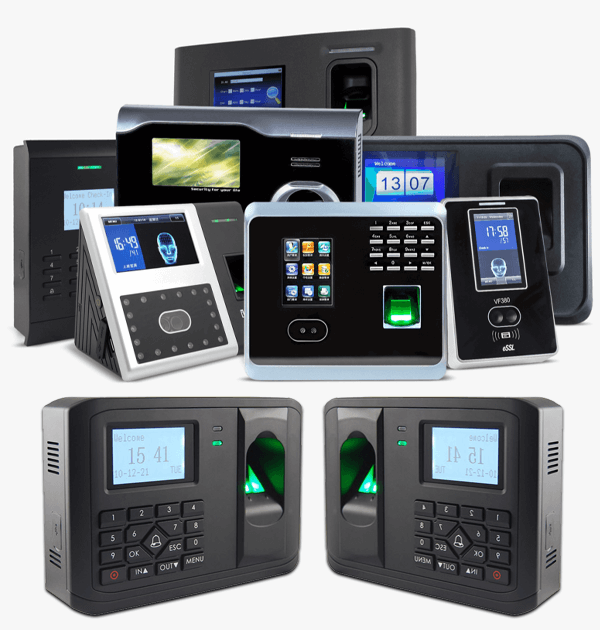
We map every access control quotation against your actual entry points, expected footfall and whether time-attendance or visitor logging needs to run on the same platform, because a system specified around the real building rather than a generic feature sheet is what actually keeps unauthorized entry out and daily operations friction-free. Devices, credential type and door-hardware compatibility are all confirmed before installation day, so the crew arrives with the right parts rather than discovering a mismatch on site.
How to Choose the Right Access Control Systems Solution
Biometric, RFID Card and Facial-Recognition: Choosing the Credential Type
Fingerprint biometric readers remain the most common and cost-effective credential type for Indian offices and factories, offering strong assurance that the person presenting the credential is who they claim to be, since a fingerprint cannot be lent to a colleague the way an RFID card can. RFID card and fob systems trade some of that assurance for speed and hygiene — a tap-and-go card reads faster than a fingerprint scan and avoids shared-surface contact, which matters for high-traffic entrances and health-conscious environments. Facial-recognition access control has become viable and affordable enough for mainstream commercial deployment in recent years, offering fully contactless, fast verification and, on more advanced units, simultaneous temperature screening, making it increasingly popular for corporate headquarters, premium office towers and government buildings prioritising both security and a frictionless entry experience. Many installations combine two credential types — card plus fingerprint, or face plus card as a backup — for higher-security doors like server rooms, cash-handling areas or record rooms.
Single-Door vs Multi-Door, Multi-Site Access Control Architecture
A standalone single-door biometric unit, configured and managed locally at the device, is sufficient and economical for a small office with one main entrance. Once an installation grows beyond a handful of doors, or spans multiple floors or buildings, a networked access control system with centralised software becomes the right architecture — allowing one administrator to manage user credentials, door schedules and access permissions across every controlled door from a single dashboard instead of configuring each device individually, which becomes unmanageable and error-prone once more than a few doors are involved. For multi-site organisations, cloud-based or centrally networked access platforms let a head-office security team manage permissions across branch locations without needing IT staff physically present at every site.
Time-Attendance Integration and Payroll Workflow
Most biometric and RFID access control platforms sold in India double as time-attendance systems, logging entry and exit timestamps that feed directly into payroll and HR software, which is a major reason offices and factories choose an access-control-based attendance system over a separate dedicated attendance device. We confirm payroll software compatibility and required report formats during specification, since not every access control platform exports data in a format an existing payroll system can ingest without manual reformatting, and a mismatch here creates ongoing administrative overhead long after the hardware installation itself is complete.
Visitor Management and Temporary Credential Handling
Corporate offices and government buildings increasingly integrate visitor management — photo capture, ID verification, temporary access credential issuance, and host notification — with their core access control system, so a visitor's presence and movement through the building is logged alongside employee access rather than handled through a disconnected paper register. For buildings with meaningful visitor traffic, we discuss whether visitor management should run on the same platform as employee access control or as a separate but integrated module, since combining the two on one system generally gives better audit-trail visibility for security and compliance purposes.
Fire Safety, Fail-Safe vs Fail-Secure Locking
Access-controlled doors must be specified correctly for fire and life-safety compliance: fail-safe locks unlock automatically on power loss or fire-alarm trigger, allowing occupants to exit freely, and are required by most fire codes for primary escape routes, while fail-secure locks remain locked on power loss, which is appropriate only for doors where security takes precedence over emergency egress, such as certain server rooms or high-security storage areas that are not designated emergency exits. Getting fail-safe and fail-secure specification wrong on the wrong door is a genuine safety and compliance risk, not just an inconvenience, and we flag this specifically during installation planning for every commercial and institutional project, coordinating with the fire-safety consultant or local fire authority requirement where one applies to the building.
Integration With CCTV and Broader Security Infrastructure
Access control delivers far more security value when it is not an isolated system — linking door events to nearby CCTV footage means a security team reviewing an alarm or an unusual access attempt can pull the corresponding video clip directly rather than manually searching hours of unrelated footage. Many modern access control platforms support this kind of integration natively or through a common video-management-system connector, and for buildings already running or planning a CCTV upgrade, we discuss access-control and surveillance integration together rather than as two disconnected procurement decisions handled by different vendors, since retrofitting that integration after both systems are already independently installed is considerably more work than planning for it up front from day one.
Government, Institutional and High-Security Facility Deployment
Rudraksh Industries is a gov registered supplier India on the Government e-Marketplace, and we regularly quote access control systems against government tender bid India requirements for secretariat buildings, PSU offices, defence-adjacent facilities and educational campuses needing controlled, auditable entry systems. If you are a gov bid contractors India firm assembling a security-systems package for a composite tender, or a department issuing an e-tender bid supplier India notice for building access control, we can supply hardware, software licensing and installation as a single line item, and act as a gov bid consultant near me India resource on door-count and credential-type specification so the tender document reflects the building's actual security tier.
Bulk and Wholesale Supply for Factories and Multi-Branch Corporates
For factories with multiple shop-floor entry points, multi-branch corporates and educational campus groups needing standardised access hardware across many doors and sites, we operate as an Access Control Systems bulk wholesaler in India with volume pricing that scales with order size, staggered delivery matched to a rollout schedule, and one consolidated GST invoice instead of scattered site-by-site purchase orders. Organisations evaluating the wholesale market in India for security-systems procurement typically find that standardising on one wholesale supplier India partner across sites keeps device compatibility and central-software licensing consistent, which matters considerably when managing permissions across dozens of doors from one dashboard rather than juggling several incompatible platforms accumulated from different local vendors over time.
Installation, Wiring and Integration With Existing Infrastructure
Access control installation involves door-side hardware (reader, electric strike or magnetic lock, request-to-exit sensor), a door controller, and wiring back to a central panel or network switch, and retrofitting this into an existing building with finished walls and ceilings requires more careful planning than a new-build installation where conduit can be run before finishing work. We assess existing door hardware, wiring pathways and whether the building already has compatible networking infrastructure before quoting an installation, since unexpected civil or electrical work is the most common source of budget overrun on access control projects planned without a proper site survey, and a survey conducted before quotation rather than after order placement avoids the awkward and entirely preventable conversation of a revised bill arriving mid-installation once work is already underway on site.
Finding a Reliable Local Partner
Search intent behind an Access Control Systems dealer near me India or Access Control Systems nearest supplier in India query is usually about who can survey the actual building, recommend the right credential type and architecture, and still answer the phone when a reader malfunctions or an employee's fingerprint stops registering. Being based in Nehru Place puts our installation and service team within same-day reach of most of Delhi NCR, while our dealer network India extends coverage to other states for larger institutional and government rollouts spanning multiple cities and branch locations.
Access Levels and Role-Based Permissions
Beyond simply granting or denying entry, a properly configured access control system assigns role-based permissions — which doors a given employee, contractor or department can access, and at what times — so a housekeeping contractor can be restricted to common areas and working hours while a server-room administrator retains round-the-clock access to a critical room. This granularity matters considerably for audit and compliance purposes in government and financial institutions, where being able to answer who could have accessed a given room at a given time is often a regulatory requirement, not just a convenience feature. We configure access-level structures during commissioning rather than leaving every door open to every credential by default, which is a surprisingly common oversight in rushed installations.
Biometric Data Privacy and Compliance
Fingerprint and facial-recognition systems store biometric templates, which raises legitimate data-privacy questions, particularly for government and larger corporate installations subject to data-protection obligations. We discuss whether biometric templates are stored locally on the device, on an on-premise server, or on a cloud platform, since this affects both data-residency compliance and what happens to stored biometric data if a device is lost, stolen or decommissioned. For organisations with strict data-privacy policies, RFID card-based systems that avoid storing biometric data entirely remain a valid and simpler alternative worth discussing during specification.
Power Backup and System Redundancy
An access control system that fails during a power outage defeats its own purpose, so door controllers and locking hardware on critical entry points should sit on a UPS or the building's backup power circuit, not solely on grid power. For high-security or life-safety-critical doors, we also discuss controller-level redundancy and local credential caching, so a door can continue verifying registered users even during a brief network interruption to the central access-control server, rather than failing open or locking out legitimate users the moment connectivity drops, which is a genuine operational risk we see overlooked in budget-driven installations that skip backup power on anything but the main entrance.
After-Sales Support, Firmware Updates and System Longevity
Access control systems are security infrastructure, not a set-and-forget purchase — firmware updates address newly discovered vulnerabilities, database maintenance keeps large multi-door installations running smoothly, and device-level troubleshooting (a reader that stops recognising fingerprints, a controller losing network connectivity) needs a responsive local service relationship rather than a support ticket routed to an overseas call centre. As an authorized dealer in India for the access control brands we carry, we provide manufacturer warranty backing plus our own after-sales team for firmware updates, troubleshooting and expansion as a building adds more doors or users over time.
Why Businesses Choose Rudraksh Industries for Access Control Systems
Rudraksh Industries specifies access control systems around the actual building and threat profile, not around whichever device happens to be easiest to sell — door count, credential type, fail-safe versus fail-secure requirements, time-attendance and visitor-management integration are all part of the conversation before we recommend hardware. As an existing GeM-registered IT, AV and networking dealer-distributor from Nehru Place, Delhi with an existing government and corporate client base, we already carry the GST billing, delivery documentation and government-tender experience that institutional and PSU buyers need, so an access control order can sit on the same purchase order as networking, CCTV and other building-security infrastructure instead of requiring a separate, unfamiliar security-only vendor relationship. We are transparent about architecture trade-offs — standalone versus networked, single versus dual-credential doors, biometric versus card-only for data-privacy reasons — rather than overselling features a building does not need, and every installation is backed by manufacturer warranty plus our own after-sales support for firmware, troubleshooting and future expansion. For factories and campuses planning a phased security upgrade, we can also sequence access control, CCTV and networking infrastructure across budget cycles while keeping the final architecture consistent, rather than each phase being designed in isolation and requiring rework to integrate later. This kind of phased planning is particularly valuable for government and PSU buildings, where budget approval for security infrastructure is often released in stages across financial years rather than as a single upfront allocation.
Bulk & GeM Procurement for Access Control Systems
Rudraksh Industries is a GeM-registered dealer, distributor, supplier and wholesaler for Access Control Systems in India, supporting both direct wholesale/bulk orders and formal government tender procurement through the Government e-Marketplace (GeM). Corporate offices, educational institutions, retail chains and system integrators regularly need Access Control Systems in quantities beyond a single-unit purchase, and as a wholesale distributor we structure pricing, delivery scheduling and configuration standardisation specifically around bulk requirements — one point of contact, consistent configuration, volume-based pricing and one consolidated GST invoice.
Why Buy Access Control Systems From Rudraksh Industries
Every order — one unit or two hundred — runs through the same GST-invoiced, GeM-compliant process.
Explore our Homepage
Frequently Asked Questions
Should we choose fingerprint biometric, RFID card, or facial-recognition access control?
Fingerprint biometric offers strong assurance since a fingerprint cannot be lent to someone else, and is the most cost-effective option for most Indian offices and factories. RFID cards read faster and avoid shared-surface contact, suiting high-traffic entrances. Facial recognition is now affordable for mainstream use and offers fully contactless, fast verification, popular for corporate headquarters and government buildings. Many high-security doors combine two credential types for added assurance.
What is the difference between fail-safe and fail-secure locks, and why does it matter?
Fail-safe locks unlock automatically on power loss or fire-alarm trigger, allowing occupants to exit freely, and are required by most fire codes for primary escape routes. Fail-secure locks remain locked on power loss and are appropriate only for doors where security outweighs emergency egress, such as certain server rooms that are not designated exits. Specifying this incorrectly on the wrong door is a genuine fire-safety and compliance risk, not just an inconvenience.
Can access control systems be integrated with our payroll and attendance software?
Yes, most biometric and RFID access control platforms double as time-attendance systems, logging entry and exit timestamps for payroll use. We confirm payroll software compatibility and required export formats during specification, since not every platform exports data in a format an existing payroll system can use without manual reformatting.
Can Rudraksh Industries supply access control systems against a government tender or GeM bid?
Yes. We are a GeM-registered supplier and regularly quote access control systems against government tender and e-tender requirements for secretariat buildings, PSU offices and educational campuses, including installation and software licensing bundled into a single line item. We can also act as a technical consultant on door-count and security-tier specification before a tender is finalised.
Do you offer bulk pricing for factories or multi-branch corporates with many doors?
Yes. For factories and multi-branch corporates needing standardised access hardware across many doors and sites, we quote wholesale-tier pricing that scales with order volume, coordinate delivery against your rollout schedule, and consolidate billing into a single GST invoice instead of multiple site-by-site purchases.
What happens if a reader or controller malfunctions after installation?
Our after-sales team handles troubleshooting, firmware updates and device replacement directly rather than routing customers to an overseas call centre. Every unit we supply carries manufacturer warranty backing, and for larger installations we can set up a service response arrangement so downtime on a security-critical door is minimised.
Is our fingerprint or facial data safe if we install a biometric access control system?
This depends on how the system stores biometric templates, so we discuss whether data sits locally on the device, on an on-premise server, or on a cloud platform, which affects both data-residency compliance and what happens to stored data if a device is lost or decommissioned. Organisations with strict data-privacy requirements can also choose RFID card-based access control, which avoids storing biometric data entirely while still providing strong, dependable door-level security for most commercial and institutional settings.
Can access control be linked to our CCTV system?
Yes, many access control platforms support integration with CCTV or a video-management system, so a security team reviewing a door event or alarm can pull the corresponding video footage directly rather than manually searching through unrelated recordings. We recommend planning access control and CCTV together where both are being installed or upgraded, since retrofitting that integration afterward takes considerably more work and cost than designing for it from the start of the project.